Welcome to Shanghai Yunhong Pharmaceutical Excipients Official Website!
-
 Hotline:021-63534350/63534360

-
中文

 Hotline:021-63534350/63534360

 Home >
News >
Market News>
Enteric Performance Without Film Coating | Hot Melt Extrusion Enables 50% High Drug Loading | Gastric Retention & Rapid Intestinal Release
 Release time:2026-11-25
 Browse:14 times
Source:
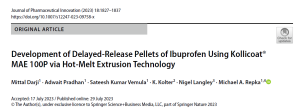
This study adopts hot melt extrusion (HME) technology with BASF Kollicoat® MAE 100P as the carrier to prepare ibuprofen enteric pellets. The drug acts as a self-plasticizer and is dispersed in an amorphous state, achieving minimal drug release in gastric fluid and rapid release in the intestinal tract. It is a solvent-free, scalable process with favorable stability.
Pain Points of Conventional Enteric Technologies
Ibuprofen is a classic non-steroidal anti-inflammatory drug with well-established antipyretic, analgesic and anti-inflammatory effects. However, its non-selective inhibition of COX enzymes may damage the gastric mucosa, frequently causing gastric pain, gastric ulcers and other gastrointestinal adverse reactions. The conventional solution relies on enteric film coating, which typically requires organic solvents and involves complicated processing steps.
Innovative HME Manufacturing Approach
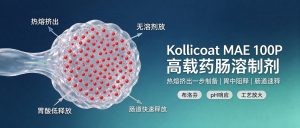
Moving beyond traditional solvent-based coating workflows, this study employs hot melt extrusion (HME) to directly use the enteric polymer Kollicoat® MAE 100P as the carrier for one-step fabrication of ibuprofen enteric pellets. The coating step is eliminated; no organic solvents are required. The process is compatible with continuous manufacturing and easy to scale up.
Formulation Screening and Characterization of Self-Plasticization
Kollicoat® MAE 100P is a partially neutralized methacrylic acid – ethyl acrylate (1:1) copolymer manufactured by BASF. It exhibits pH-dependent solubility and dissolves at pH > 5.5. Traditionally used as a film-forming polymer for enteric coating, it normally requires additional plasticizers. Notably, ibuprofen itself functions as an unconventional plasticizer. As drug loading increases, extruder torque decreases markedly, weakening intermolecular forces within the polymer and improving processability without extra plasticizers.
In Vitro Dissolution and Release Performance
Formulations with three drug loadings (40%, 50% and 60%) were extruded at 120 °C, 130 °C and 140 °C respectively. Characterizations including DSC, hot-stage polarized light microscopy and FTIR confirm that in the optimal formulation (50% drug loading, extruded at 130 °C), ibuprofen is homogeneously dispersed in the polymer matrix in an amorphous state. Intermolecular hydrogen bonding forms between the drug and polymer, showing good miscibility.
In vitro release was tested by the USP paddle method: dissolution was first performed in 0.1 N HCl (simulated gastric fluid) for 2 hours, followed by switching to pH 6.8 intestinal buffer. The pellets released less than 1.5% of the drug within 2 hours under acidic gastric conditions, effectively preventing gastric drug release and mucosal irritation. Upon transfer to the intestinal environment, complete drug release was achieved within another 2 hours, meeting the specifications for delayed-release dosage forms.
Process Scalability and Stability Evaluation
The formulation was successfully scaled up from a MiniLab micro extruder to an 11 mm twin-screw extruder. The similarity factor f₂ of dissolution profiles before and after scale-up reached 76.79, demonstrating excellent process reproducibility.
Stability testing shows that after one month of storage at 25 °C / 60% RH, the drug remains amorphous and the dissolution profile shows no significant change.
✅ Key Highlights:
This approach offers an alternative strategy for enteric dosage form development.